

Assurance integrity in a changing risk landscape: How ISEAL members are strengthening practice with the Assurance Integrity Framework
The integrity of assurance depends on having sufficient accuracy and reliability of assurance results. For sustainability systems, maintaining and strengthening their assurance integrity requires a proactive and adaptive approach.
In today’s fast-changing environmental and regulatory landscape, it is more important than ever that sustainability systems adapt to ensure they can continue to deliver assurance results with confidence. By focusing on the integrity of assurance, sustainability systems can more meaningfully support change with other actors across the wider sustainability landscape, such as through corporate due diligence policies. For example, when considering whether a sustainability system can meaningfully support corporate due diligence, assurance quality and integrity criteria is one of the three main dimensions sustainability systems are assessed against.
Given the growing importance of assurance integrity, we have developed the Assurance Integrity Framework to help ISEAL Community Members assess, improve and strengthen these foundations.
What is the Assurance Integrity Framework?
The Assurance Integrity Framework supports sustainability systems through three steps:
- Building organisational knowledge: it includes practical insights about what a sustainability system needs to have in place to be able to strengthen assurance integrity, from foundations to outcomes and essential activities
- Identifying opportunities for improvement: it includes an online self-assessment that allows members to identify if any essential activities are missing and to measure improvement in introducing these activities over time
- Defining improvement strategies: it provides further guidance and examples to help members make informed decisions about how to address any gaps identified in the self-assessment
The Assurance Integrity Framework can be used in conjunction with, or to complement, other ISEAL tools. For example, as effective risk management relies on good data, and ensuring that insights from data are used to informed decisions, using it alongside the Data Maturity Rubric can enable members to identify improvements that can enhance both their data capabilities and capacity to detect and manage integrity risks at the same time.
Building the foundations of assurance integrity
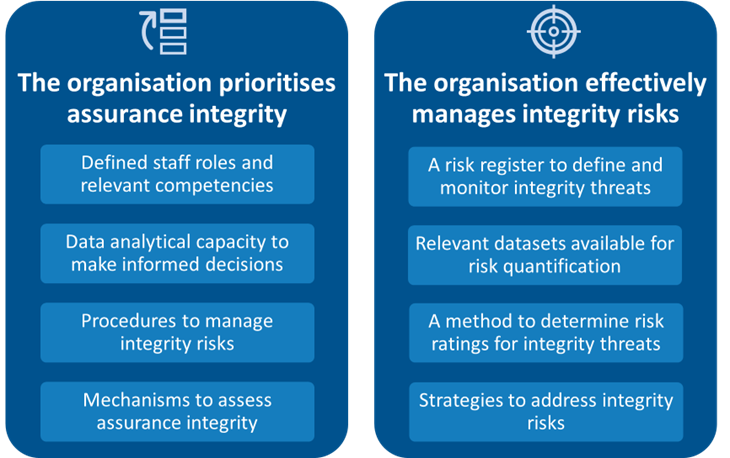
The Assurance Integrity Framework outlines two key foundations that underpin a sustainability systems’ capacity to strengthen assurance integrity:
- The organisation prioritises assurance integrity
Prioritising assurance integrity, or building an assurance integrity mindset, is important because assurance integrity is impacted and dependent on decisions and activities that occur on an operational level across the sustainability system (such as data strategy, staff resourcing), as well as within other core scheme components (such as standard-setting, monitoring & evaluation).
One simple way that sustainability systems can prioritise assurance integrity is by ensuring that relevant staff across the organisation understand what assurance integrity risks are, what processes are in place, and what role they have in maintaining assurance integrity, such as gathering data on integrity risks to report back to the assurance team.
- The organisation effectively manages integrity risks
The most impactful change a sustainability system can make to increase the accuracy and reliability of assurance results is to improve their risk management approach. Through more accurate detection and analysis of integrity risks such as fraud, conflicts of interest, or competency challenges, sustainability systems are better able to identify effective risk treatments and monitor this over time.
Managing integrity risks includes introducing strategies to address issues that could undermine assurance results, such as insufficient auditor competency. Global Organic Textile Standard’s (GOTS) Innovations Fund project on Continuous learning from auditors on due diligence requirements involved strengthening auditors’ understanding of GOTS’ due diligence criteria through a continuous learning approach that covered issues such as workplace pressures, gender issues and cultural awareness. This helped support auditors to better identify human rights and environmental risks when in the field.
By understanding and addressing these two key foundations, sustainability systems can strengthen the accuracy and reliability of assurance results. For ISEAL Community Members, the Assurance Integrity Framework provides a clear, actionable pathway for taking this work further.
Supported by

This work was made possible through generous funding from the Swiss Secretariat of Economic Affairs.